
Eccentric Training: Why Slowing Down Might Be the Smartest Move in Your Workout
If you spend enough time in a gym, you’ll hear people talk about “doing negatives.” It sounds technical, but it’s actually pretty straightforward. They’re talking about the part of a movement where you lower the weight, but only, instead of rushing through it, you take your time. That’s essentially what eccentric training is: paying attention to the lowering phase of an exercise and doing it slowly, with control.
So what’s really happening in your muscles?
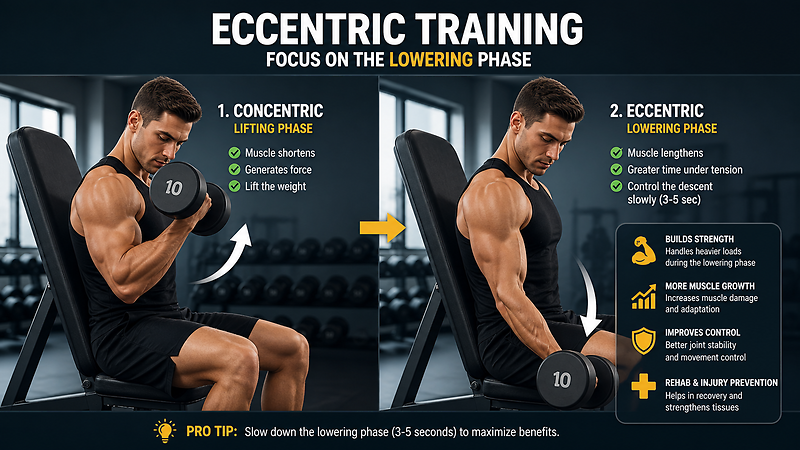
Every rep you do has three parts. You lift the weight (that’s the concentric phase), you briefly hold it, and then you lower it back down. That last part, the descent, is where eccentric training lives.
Most of us don’t think much about it. We lift with effort, then drop the weight back into place. But when you slow that lowering phase down, your muscles are forced to stay engaged longer. They’re working against gravity, trying to control the movement instead of just letting it happen.
Why it actually matters outside the gym
This isn’t just about building muscle. Think about walking down stairs, sitting in a chair, or even carrying something heavy and placing it down carefully. Your body relies on this same kind of control all the time. That’s eccentric strength. Your muscles lengthen while still under tension. It helps you move smoothly instead of collapsing into motions.
What makes it different from regular training?
Here’s the interesting part: your muscles are actually stronger when they’re lengthening than when they’re shortening. So during the eccentric phase, you’re capable of handling more load even if it doesn’t feel that way immediately.
Another surprising bit? It doesn’t drain you as quickly. You can generate a lot of force without burning through as much energy, which makes it a pretty efficient way to train.
The benefits people notice
1) For starters, strength tends to improve faster when you include slower, controlled reps. Muscle growth also gets a boost because of the extra tension placed on the fibres.
2) Athletes often use this method to improve control and power, especially in sports where sudden stops or changes in direction are common.
3) It’s also widely used in rehab. If someone’s recovering from an injury, especially around tendons, controlled lowering exercises can help rebuild strength without putting too much strain on the joint.
How to start without overdoing it
You don’t need a completely new routine. Just tweak what you’re already doing. Next time you squat, lower yourself over four seconds instead of one. Same with push-ups or dumbbell curls. A couple of sessions a week is enough to see a difference.
A few things to watch out for
It’s easy to get carried away. Since you feel in control, you might be tempted to go heavier than you should. That’s usually when form slips or soreness goes through the roof. Keep it simple. Move well, stay controlled, and don’t rush the process.
Eccentric training isn’t about doing more, but it’s about doing things better. Slowing down forces your body to work in a way it usually avoids. And over time, that added control translates into strength you can actually use, not just in the gym, but everywhere else too.